Building Scalable MERN Applications: Architecture, Performance & Production Best Practices
A complete guide to building scalable MERN stack applications with proper architecture, performance optimization, and production-ready strategies.
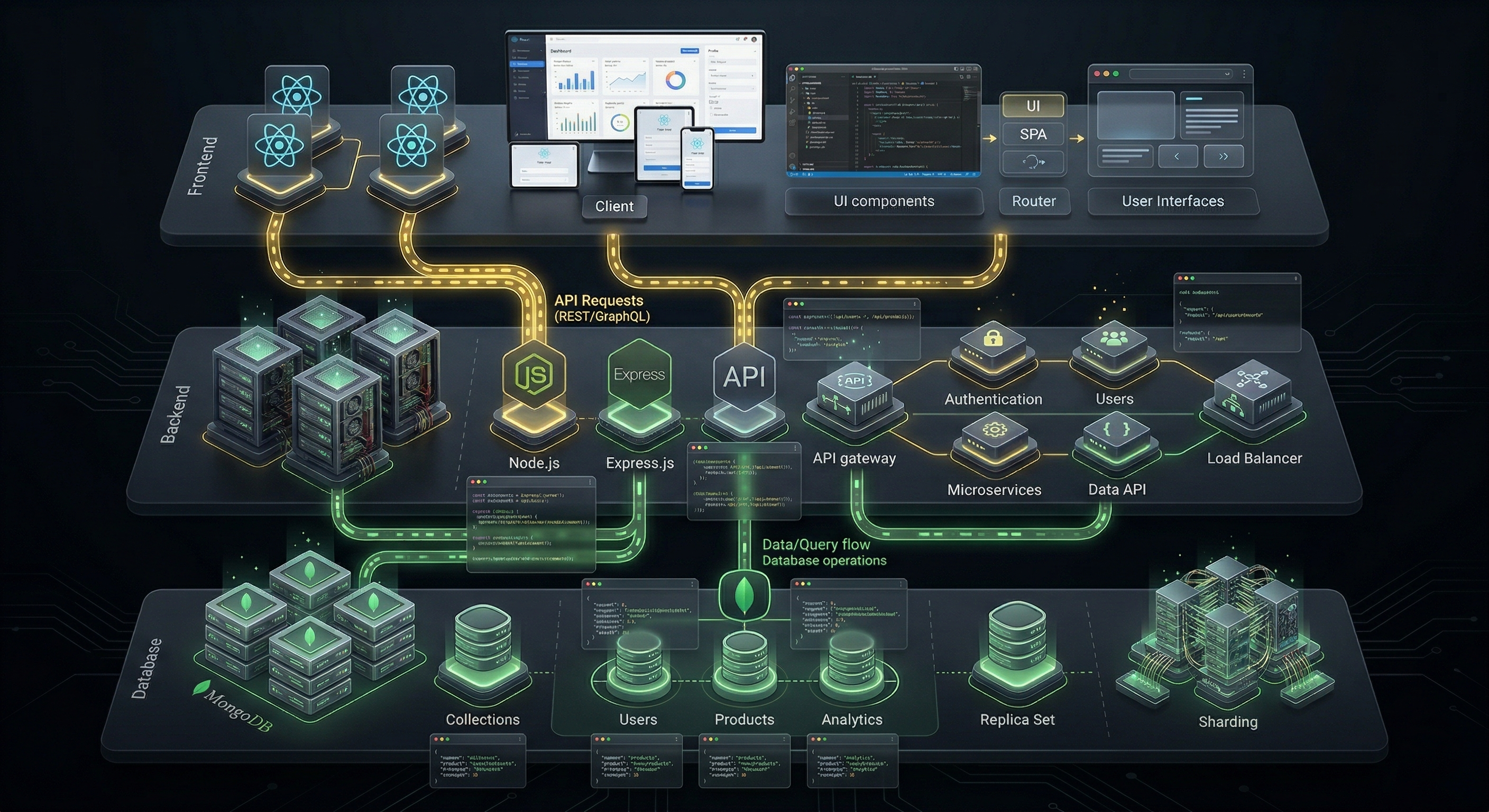
Building Scalable MERN Applications: Architecture, Performance & Production Best Practices
Building a MERN application is easy. Building one that can handle thousands — or even millions — of users is where the real challenge begins.
Most applications fail not because of bad features, but because of poor architecture and lack of scalability planning.
In this guide, we’ll explore how to design and build production-ready MERN applications that scale efficiently.
🧠 High-Level Architecture
A scalable MERN application should follow a layered and modular architecture:
Client (React / Next.js)
                ↓
        API Layer (Express.js)
                ↓
      Business Logic (Services)
                ↓
        Database (MongoDB)
                ↓
      Caching Layer (Redis)
Key Idea:
👉 Separate concerns clearly — UI, logic, and data should never be tightly coupled.🧱 Project Structure (Clean & Scalable)
src/
├── controllers/
├── services/
├── models/
├── routes/
├── middleware/
├── utils/
└── config/
👉 Why this matters:
- Easier debugging
- Better scalability
- Team collaboration
⚡ Database Optimization (MongoDB)
Database is often the bottleneck in scaling apps.
Best Practices:
- Use indexes for frequent queries
- Avoid unnecessary joins
- Use pagination instead of loading everything
const userSchema = new Schema({
  email: { type: String, unique: true, index: true },
  name: String,
  createdAt: { type: Date, default: Date.now, index: true }
});
👉 Tip:
👉 Always analyze queries using MongoDB Compass or explain()
🚀 API Design (Production Ready)
A good API is predictable, structured, and scalable.
Example Response:
{
  "success": true,
  "data": [],
  "meta": {
    "page": 1,
    "limit": 10,
    "total": 100
  }
}
Must Have:
- Error handling middleware
- Validation (Zod / Joi)
- Rate limiting
⚙️ Performance Optimization
1. Caching (Redis)
- Store frequently accessed data
- Reduce database load
2. Lazy Loading
- Load data only when needed
3. Compression
- Use gzip or brotli
🌐 Scaling Strategies
Horizontal Scaling
Run multiple instances behind a load balancer.
CDN
Serve images and static files via CDN.
Microservices (Advanced)
Break large apps into smaller independent services.
🔐 Security Best Practices
- Use JWT authentication
- Sanitize inputs
- Protect against XSS & CSRF
⚠️ Common Mistakes
❌ Mixing business logic in controllers
❌ No indexing in database
❌ Large API responses
❌ No caching strategy
🧠 Developer Mindset Shift
To build scalable systems:
- Think in systems, not just features
- Optimize for performance, not just functionality
- Write code for future growth, not just current needs
🏁 Conclusion
Scalability is not something you add later — it must be built into your system from day one.
By following proper architecture, optimizing performance, and avoiding common mistakes, you can build MERN applications that are not just functional, but truly production-ready.
The difference between a good developer and a great one is not in writing code — but in designing systems that scale.
Enjoyed this article?
Share it with your network